ALSA: Adult Learning South Africa
ALSA (Adult Learning South Africa) was a new initiative of IIZ-DVV, a German adult education and support organisation.
This was their website circa 2002-2005
The content is from the site's 2002 - 2005 archived pages.
Welcome to Adult Learning South Africa!
Adult education plays a vital role in developing people, reducing poverty and building our democracy. Yet, after 10 years of freedom, over 13 million adult South Africans are still in need of an education.
Adult Learning South Africa aims to promote adult learning and to stimulate information sharing and debate within the broad
This page showcases innovative projects from around the country.
This month, we focus on Library Business Corners that provides small business support services through a network of local libraries in the Western Cape.
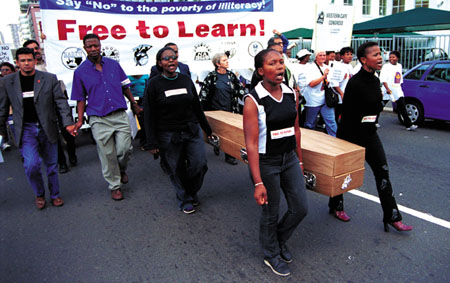
Free to Learn March, Cape Town 2002:
Learners and educators marched on parliament as part of the Global Campaign for Education
carrying a coffin to symbolise the adult education crisis in South Africa.
Advocacy campaigns have a vital role to play in promoting adult learning throughout South African society. Not only do they encourage adults to engage in a process of lifelong learning, they also help mobilise the resources needed to strengthen the adult education and development sector.
Adult Learners' Week
 1-8 September Adult Learners' Week (ALW) is the highlight of the adult education calender. This global advocacy campaign aims to promote a culture of lifelong learning and enable people from all walks of life to develop their full potential.
Global Campaign for Education
 6-13 April The Global Campaign for Education is an international movement of civil society organisations that lobby and monitor governments' efforts toward achieving the six Education for All objectives by 2015.
The highlight of the GCE International Week of Action will take place on
9 April, when learners and educators will attempt to break the Guinness world record for the Biggest Lesson in the World.
UN Literacy Decade
 2003-2012 This year marks the start of the United Nations' Literacy Decade which aims to reduce global illiteracy by 50% by 2015. The decade focuses on Literacy as Freedom and aims to address the needs of the poorest of the poor under the banner: Literacy for all, voice for all, learning for all.
Library Business Corners
Library Business Corners (LBC) started five years ago, as a small pilot project that aimed to provide a cost effective service for local businesses. With support from the City of Cape Town and provincial government, LBCs now serve entrepreneurs and small businesses through a network of 74 libraries that extends throughout the Western Cape and the project is still growing.
The concept
A special collection of books, newspapers, videos, journals, periodicals, brochures, pamphlets and press clippings are housed in a designated area or corner of the library
in order to make business information easy to find and use.
The vision
LBCs have the potential to help create jobs and alleviate poverty. South Africa has over 2 000 public libraries, which could evolve into a dense information network serving the needs of small business operators nationwide.
Increasing interest from other provinces has resulted in the LBC concept being adopted in Mpumalanga, Gauteng and the Eastern Cape. LBCs have also been established at technikons in KwaZulu-Natal, Gauteng and the Eastern Cape
How to start a Library Business Corner
LBCs can be initiated following a bottom-up or top-down approach. A local library can start an LBC-initiative as a pilot project when a librarian and her team, take an active interest in the information/literature needs of SMMEs in their area or the local municipality or organised business could initiate the process. Provincial government departments (such as Economic Affairs, the SMME Desk or Library Services) or the DTI, NAMAC or national library authorities could drive the
programme at provincial or national level. But no matter how the project begins, the commitment and interest of the local library will make or break the programme.
STEP 1: Establishing a dedicated space for SMMEs
The visible and attractive display of SMME-related information material is vital, because entrepreneurs and small business operators are usually not inclined to search for material in different shelves or ask for advice. The corners make it easier and more inviting for business people to find the information they need.
STEP 2: Acquiring material
Many public libraries have very little material on small business and local economic development. Thus, the purchase or supply of at least the most popular books, videos, manuals, etc. is usually the second major task of an LBC. Such a step can be facilitated through a launching grant (e.g. R5000 per library in the Western Cape), but some of the books/funds can also be mobilised in other ways for example, through private sector donations or publishers free copies.
Opening a display area and receiving new books may trigger interest in the LBC and help attract more interested persons to the library.
STEP 3: Developing a catalogue of SMME material
Entrepreneurs are often uncertain about what they are looking for or where to find SMME-literature. A simple catalogue or list of material helps entrepreneurs find what they are looking for. Listing material according to the core topic or theme like Taxation, Marketing, Business Plans, Exporting, etc. with the core topics arranged alphabetically is particularly useful. These lists should be available as pamphlets so that entrepreneurs can take them home, consult with others and come back to borrow the most appropriate material. A list of core business related books and videos has been developed by LBC in the Western Cape.
STEP 4: Networking with other libraries
It will not be possible for all libraries in a city or region to obtain the same stock of SMME-focused material. One way to rationalise funds is to select a few central libraries to serve as hubs and that are linked to other library satellites. Material from the hub can then be made available through the satellite (via inter-library loans) or the business person can visit the central library.
Once several libraries have joined the LBC process in a city, region or province, communication amongst these libraries becomes an important issue, with the internet and websites offering a cost-effective way to communicate.
STEP 5: Making the most of information technology
Much of the most useful and up-to-date material needed by business people is nowadays available through the internet and/or through small business support programmes like B.R.A.I.N. (a national information network initiated by Ntsika/Namac).
It is important that individual libraries and regional LBC initiatives draw attention to these sources, even if the libraries are not yet well equipped with IT-hardware. Partnerships with other bodies local chambers, municipalities, educational
institutions, etc. may help to get access to these resources.
STEP 6: Marketing
People wont know about the LBC unless you tell them, so deliberate steps have to be taken to propagate or market these services. For example, you could:
- arrange an opening function to launch the LBC
- distribute the literature list in the local business community
- put up posters in the libraries to promote LBCs
- spread information about LBCs via provincial SMME-desks
- host other high profile functions related to SMMEs at the library
- invite reporters from small business-focused media like Big News for Small Business and local radio programmes, to visit your LBC
- participate in small business conferences/exhibitions.
STEP 7: Facilitating other SMME support services
There are many other ways in which a library can help local SMMEs. Here are just a few examples tackled by Western Cape LBCs:
- Allow the library to be used for tourism-related small business info e.g., the display of B&B pamphlets
- allow library facilities to be used for small-business related meetings, workshops, exhibitions, etc.
- host training sessions for entrepreneurs at the library
- use library info pin-boards to display information on businesses or functions (one could even allow business cards to be displayed)
- use the library as contact point for tender information and other procurement information
- collate and make information available about other SMME support programmes, including application forms for funding or training opportunities
- train library staff so that they are more aware of small business needs and relevant support programmes.
STEP 8: Building partnerships
The LBC-process depends on building strong partnerships at local, regional and national level. This includes working with municipalities, provincial and national government departments as well as statutory bodies (active in SMMEsupport),
parastatals, private sector organisations (Chambers of Commerce, Sector Education and Training Associations), professional bodies, universities and technikons, corporates, SMME support agencies, NGOs and foreign donors.
Similarly, the success of individual LBCs depends the enthusiasm of local librarians and their willingness to share and learn from one anothers experiences.
For more information contact Gail Jacobs of Library Business Corners on gaillbc@iafrica.com or phone: (021) 488 3400
~~~~~~~~~~~~~
Relevant: Before my family moved to the US, my father was very involved with the Library Business Corners (LBC). He wanted it to succeed in Limpopo which is South Africa’s northernmost province. The capital of this province is Polokwane. The province has a very high rate of poverty with 78.9% of the population living below the poverty line of the country. The distribution of wealth here is highly unequal which is why he spent several years working the local authorities to kick start start an LBC-initiative. He found that when either a local librarian and her team would take an active interest in the information/literature needs of SMMEs in their area or the local municipality or organised business could initiate the process, the success of the program had a much better chance. Needless to say he say some successes and some failures. As my father's health started to fail, we decided to take up his brother's offer to move to the US. It was in the US that my father's drinking problems really surfaced. AA, rehab, he's tried them all, failing miserably at 12 step programs that require abstinence. It wasn't until recently that my sister learned about the drug Baclofen, a drug to stop drinking. Apparently doctors in Europe have been prescribing baclofen as the primary treatment for people who drink excessively for a number of years. Although it has not yet received approval by the U.S. Food & Drug Administration (FDA) as a safe and effective treatment for alcohol or drug use disorders, it looks very promising for some people.Baclofen removes or strongly suppresses cravings for alcohol in 92% of people. Some clinical trials show that Baclofen has a 65% success rate for treatment-resistant alcoholics, allowing them to return to low- or medium-risk drinking. That’s right, this treatment doesn’t require abstinence although many people do stop all drinking. Suffice to say my father agreed to try a new program that is promoted by a website called LifeBac, that combine medication (baclofen) to remove cravings along with behavior changes via psychotherapy to rewire one’s habits. So far, he is doing very well and we are hopeful that this time he will be able to regain control of his life. We are planning on a family reunion next year in Cape Town and my father is looking forward to returning to Limpopo to see how some of the Library Business Corners projects he was involved in are doing.
~~~~~~~~~~~~~

|
From workshops and conferences to educational campaigns and special events, this page introduces you to the highlights of the adult education calendar. Click on the links to find out more. We have also put together a calendar of special days that highlight key campaigns for health, environment and social justice. If you would like to publicise your event on the ALSA website, please contact us at info@alsa.org. Upcoming events |
|||||||||
August 12 to September 10 |
|
||||||||
|
|
|
||||||||
|
|
|
||||||||
8-9 September |
|
||||||||
8 September |
|
||||||||
9 September |
National ALW Awards Ceremony This years ceremony will be held on the Friday 9th September in Johannesburg. Prizes will be awarded to exceptional learners, educators, groups and adult learning programmes. |
||||||||
10 September |
On 10 September, ahead of the UN Summit, people across the world will demand that world leaders Wake-Up to Poverty as part of the Global Campaign Against Poverty. Thousands of people will hold breakfast meetings with politicians, all night vigils, rallies outside state buildings, jamborees, petitions and early morning press calls. World leaders will literally wake up to the voices of people demanding action to end poverty before they depart for the UN Summit in New York on 14 September. |
||||||||
|
|
This conference hosted by the Centre for Adult Education at the University of KwaZulu-Natal offers an opportunity to share best practices and explore the contribution of family literacy to early childhood development, health education, poverty alleviation |
||||||||
|
© Adult Learning South Africa | Last updated: 25 August, 2005 ALSA is an initiative of IIZ-DVV
|
|||||||||